Tuesday, April 04, 2006

A Depressing Case of Disillusionment


Moulin Rouge (1952)
Starring: Jose Ferrer, Zsa Zsa Gabor, Suzanne Flon, Colette Marchand
Written and directed by: John Huston

(Photo courtesy of shutterfly.com)

On the surface it looked perfect: the original Moulin Rouge (the inspiration for Baz Luhrmann's vibrant adaptation,) fantastic character actor Jose Ferrer, the divine Zsa Zsa, and directed by none other than John Huston, previously of The Maltese Falcon and The African Queen, both essentials of classic cinema. It's the perfect combination, no?

NO.

This... this thing betrayed me! The first scene in the famed Paris nightclub lures one into a false sense of security. The place is dirty and the capering girls are loose and obnoxious with bad teeth. Ah, I thought to myself, this is Paris in the nineteenth century: brash, luridly glamorous, petticoats a-flying and legs akimbo. The painter Henri de Toulouse-Lautrec (Ferrer) sits at a table in the club, downing a bottle of cognac and drawing sketches of the dancing girls right on the tablecloth. He throws out zingers and one-liners, one after the other, like finely tuned right hooks; he is bitter and drunk. He is fabulous.

Then Zsa Zsa comes out and starts singing and the whole thing goes down the tubes.

Perhaps it was my fault. Perhaps I was spoiled from enjoying this experience by Luhrman, Nicole Kidman and her fiery rendition of "Diamonds are a Girl's Best Friend," and a far jollier version of Toulouse by John Leguizamo. But when Gabor came out in a bizarre plumed hat (see above) singing about "Flowers in April," as the so-called star of the Moulin Rouge, I got a slow sinking feeling in the pit of my stomach.

The movie just gets wierder from here. We are offered a lengthy flashback which recounts the reason for Toulouse's bitterness: he was injured in childhood when he fell down a flight of stairs. Or, as the movie would have you believe, launching himself down the stairs in a sad attempt to make it look like an accident. Whatever happened, the bones in his legs didn't knit, stunting his growth. His girlfriend leaves him because he's a cripple, his father laughs derisively at his childhood sketches, blah blah blah. Fast-forward to the present, and Toulouse enters into two tumultuous relationships- one with a street girl, Marie (Colette Marchand,) and another with a mature woman named Mryianne (Suzanne Flon.) He struggles to balance his art, his relationships, his family name, and his increasing descent into alcohol.

Ferrer becomes increasingly irritating through all of this, and his snappy delivery becomes more and more monotonous. Ok, we get it, you're angry and bitter at life! I would comment on Marchand's performance, except I couldn't understand a word she was saying. The editing was laughable, the music was grating, the plot becomes more and more useless and almost bored with itself... I could go on and on.

While I was doing a little research here and there, I found a most disturbing tidbit of information: this movie was nominated for an Academy Award- several in fact. And it won for Best Costumes and Best Art Direction. It was also nominated for Best Picture and and Marchand got a nod for Best Supporting Actress. One of the worst movies I had seen in a long time, and it got nominated for Best Picture. There is no justice in the world.

It might have been all right if the movie was amusingly bad (see prior post on Snakes on a Plane) but it's just dull, dry, and uninspiring. Perhaps it's not entirely the movie's fault- it would be hard to impress someone who's seen Luhrmann's adaptation, and even harder to beat Leguizamo's lovely performance. But whoever's fault it is, there's no excuse for that kind of betrayal.

Monday, April 03, 2006

I'm So Excited I Can Only Write in Simple Sentences


There's a new movie coming out this summer.

It's about a guy who wants to kill this person who's going to testify against him.

So he releases a whole crate of poisonous snakes on the plane the witness is on to kill him.

You know what it's called?

Snakes on a Plane.

No, I'm not kidding.

Click the link above- you'll find the IMDB listing for it. Heck, have it's official website link too.

Interesting. The official website doesn't have much except a link to a fan site, and New Line Cinema's logo.

Not even a synopsis of the movie.

But then you don't really need one, do you?

It's a movie about snakes on a plane.

'Nuff said.

Gets straight to the point- I like that.

Anyway, Samuel L. Jackson's in it.

The IMDB listing says that Jackson took the part purely for the title. He was adamant it not be changed when they began marketing the movie.

I like Jackson's moxie. Only he could star in a movie entitled Snakes on a Plane and still maintain a shred of dignity.

Here's one of his lines:

"Enough is enough. I've had it with the snakes."

Is that not the best line ever uttered in film? So decisive, so take-charge!

So, I guess the conclusion to this silly little interlude is obvious:

I can't wait to see Snakes on a Plane. I'm purchasing tickets as soon as they're available.

And Samuel L. Jackson is the coolest man alive.

That is all.

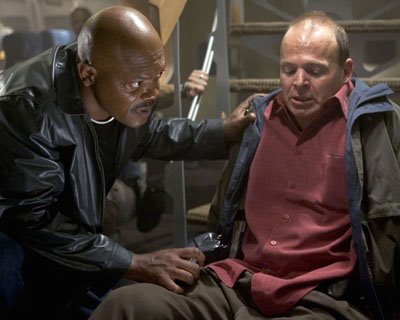
(Photo courtesy of About.com)

Friday, March 31, 2006

She's the Man is a New Way of Filmmaking... Ummm Ok

I'll preface this post by saying that I have not seen the new Amanda Bynes movie She's the Man, a modernization of Twelfth Night. So I have no reason to talk. But when I read New York Press film critic Armond White's fawning review of the film, something just didn't sit right with me. Let's have a little blockquote for context, shall we? (Bold type added by me.)

She’s the Man operates at a less literal level than such ’80s drag comedies as Soul Man and Just One of the Boys, and it’s not a sophisticated comedy-of-drag manners like Clare Peploe’s dazzling 2002 film of Marivaux’s The Triumph of Love. Instead, director Andy Fickman and a trio of screenwriters simplify Shakespeare’s plot to offer an innocuous, but buoyant, moral lesson. Avoiding the gender pathology of Boys Don’t Cry, they’ve done what most purveyors of pop culture don’t think to do: borrow from the past for edification. She’s the Man’s modest and, yes, corny use of Shakespeare offers contemporary filmgoers what Max Ophuls called The Memory of Justice.

Most purveyers of pop culture don't think to use the past for edification in film? Is he kidding me? The past ten to fifteen years of popular mainstream film have been nothing but homages to classic literature and theatre. Clueless was based on Jane Austen's Emma. She's All That was based on My Fair Lady, which was based on the Greek play Pygmalion. 10 Things I Hate About You was based on The Taming of the Shrew (which was also the inspiration for Kiss Me Kate.) And in the name of all that is holy, what was Baz Luhrmann's Romeo + Juliet, if not a pop culture opus edifying Shakespeare's love story? What was Moulin Rouge, if not a mingling of the past and present to create a portrait of universal themes that everyone, including Shakespeare, have dwelled on? For crying out lout, what was freaking Shakespeare in Love?

And those are just the ones I could think of in the past five minutes.

She's the Man may be a fine ol' time (preliminary reports indicate that it actually isn't horrible- see here and here for other reviews) but it certainly isn't the first of it's kind, or even the most striking. If anything, the old "borrowing from the past for edification" game is getting a little tired.

Tuesday, March 28, 2006

Because the World Needs Midnight Viewings of Hudson Hawk

The Brattle Theatre is not a movie palace. Unlike the other art house theatres along the muddy Charles River- Coolidge Corner, Kendall Cinemas, the Somerville Theatre- the Brattle is like an old sweater, threadbare and strangely comforting. Creative director Ned Hinkle says it "has character," which is a pretty accurate description. Old spotlights hang from the ceiling, a remembrance when the theatre was a venue for live theatre. The carpeting is old and musty, a huge neon clock proclaims the time for the audience sitting in the dark. Creaky stairs lead to the balcony, directly above the extra seats which are set up to accommodate any stragglers into the 250-seat theatre.

But it's not the aesthetics of the place that brings people to the Brattle, or instills such a profound attachment for the venue. It's the programming. Ever since it's inception as a cinema, the Brattle's proprietors have had a mission to bring films that you can't find anywhere else. One of their greatest coups was finding a print of Eisenstein's Ivan the Terrible Part II, which was thought to be destroyed by Stalin during the Cold War. They were among the first theatres in the country to show important cinema that failed financially but survived the tests of time: Welles, the French New Wave filmmakers, and foreign cinema that wasn't state funded. It was a gathering place for the artistic, the avante garde and the curious.

In short, it's one of a dying breed.

The Brattle got another shot at life, however, when its owners announced last year that without a massive fund-raising campaign the tiny theatre could be shut down forever. It was a call to arms for the Boston/Cambridge community, who poured in the moolah, winning the Brattle owners a year's extension on their lease. But they still have to raise $250,000 by the end of this year, so if anyone in the area has a spare farthing or two, toss it in the Brattle's poor bucket. It'll be a donation not just for the Brattle, but for the scores of interesting, independent, foreign and just plain weird movies the Brattle makes it's mission to show.

Oh yes, a quick explanation of the title before I move on...

Hudson Hawk, for those who are not fortunate enough to know, was one of Bruce Willis's vanity projects, very bad, and very entertaining. It includes just about everything and the kitchen sink, but here's a couple running themes:

1. A kidnapping
2.The works of Leonardo Da Vinci (without having to wade through pages and pages of Dan Brown's overblown ego! Huzzah!)
3. Mystical (or at least very shiny) crystals hidden in the works of Da Vinci.
4. Musical action sequences.
5. It's complicated. And the plot doesn't really matter anyway.

In any case, the Brattle had two midnight showings of Hudson Hawk last weekend (their April Fool's Guilty Pleasure feature!) It's just a little break from their fancy-schmancy intellectual-type movies. Art theatres have a sense of humor too, despite popular belief.

So, I say again, drop a tuppance in the Brattle's coffers. Do it for art. Do it for Eisenstein. Do it for Hudson Hawk.

Fun With Maturity!!!

I've played this game many a time with Mother Maven and her compatriots, and recently had an exciting round with The Roommate in the noble pursuit of procrastination.

Here are the rules:

Each player names an actor or actress. The other players have to decide whether they think that actor is a "boy" or a "man" (with actresses of course it's 'woman' or 'girl.') If a player disagrees they are to, um, disagree vehemently and state their case. Then all players decide by democratic vote who is correct. Generally, whether an actor is a boy or a man depends upon the roles said actor plays, although the behavior of said actor in real life can also be debated.

Example: George Clooney is a man. Topher Grace is a boy.
Female Example: Emma Thompson is a woman. Kirsten Dunst is a girl (except in Interview with the Vampire, where, ironically she was a girl playing a girl who acted like a woman. Oh, those pesky vampires!)

Now comes the tricky part. Occasionally one will run across an actor/actress who defies simple categorization. Either their roles have been too diverse and complex, or they are pathetic man-children who haven't yet reached a mature stage in adulthood that can register in their performances. In such a case, The Roommate and I have decided that there should be a merging of said maturity levels- "Moy" and "Wirl," respectively. The naming of a Moy or Wirl must be sufficiently explained to come into play.

Example: Johnny Depp is a Moy, mainly because his chameleon-like ability to morph into whatever character is required enables him to be alternately boyish and playful or manly at will. It is a rare gift.
Female Example: Kate Winslet is a Wirl, because she is able to integrate both a girlish cute factor without being nauseating, as well as an ability to fit into complex and mature roles. Also a rare gift.

There are no winners or losers in this game, and you can play until exhausted and/or bored with the entire affair. Play it with your friends! Play it with your family! Play it with a stranger on the bus! Or you could just debate below in my fabulous comments box. Enjoy!

Saturday, March 25, 2006

The Three Faces of Eve

The Three Faces of Eve (1957)
Starring: Joanne Woodward, David Wayne, Lee J. Cobb
Written by: Hervey Cleckly, Corbett Thigpen (book,) and Nunnally Johnson
Directed by: Nunnally Johnson
IMDB listing

The first time I ever saw Joanne Woodward in a film was when my Art, Drama and Music professor showed The Fugitive Kind, a humid, glorious retelling of the Orpheus myth adapted from Tennessee Williams's play Orpheus Descending. I've watched it many times since then- at first I was understandably preoccupied with a very young, very beautiful Marlon Brando, who played the tragic hero. But after awhile, I began to notice Woodward's fabulous performance as a wild New Orleans party girl. Woodward thrashed around barefoot in an old party dress through most of the movie, loud and obnoxious and entirely captivating.

Since then I've seen her in several other films, including Empire Falls, Philadelphia, and Sybil. But never have I seen her talents employed in such brilliant quality as in The Three Faces of Eve. Woodward is Eve White, a mousy housewife unwittingly suffering from multiple personality disorder. It's interesting how almost frivolous the plot seems now. The worst thing that came of her illness was her idiotic husband (David Wayne,) and the film fast-forwards through many of Eve's breakthroughs, making the entire process of personality integration seem a lot easier than it actually is. The movie also skirts completely around the issue of sexual abuse (the typical trigger of dissociative identity disorder) and tries to convince us that Eve's illness was caused by a far more innocuous experience. It may have played in 1957, but after the main viewing public got a load of Sybil (coincidentally in which Woodward played the title character's psychiatrist,) the movie has a bit of a dated feel.

But that's not to say it isn't worth viewing; quite the opposite. Woodward is a lone star in this movie. Her three characters are the only principles. Her husband, doctor and daughter all revolve around her like planets around the sun- they become part of the scenery around which Woodward tells her story. As she shifts between each of her personalities, she closes her eyes, like a young actress preparing for an audition. Her rhythm between the beaten Eve White, the tumultuous Eve Black, and the elusive Jane is impeccable. It's pure classic Hollywood- you know the entire time that you're watching a trained actress in a performance. But the illusion of it is so well-played, it makes absolute realism or even scientific accuracy unnecessary.

Tuesday, March 21, 2006

The Theatricality of Discomfort

You know what I have in my hand right now? Come on, guess. Come on! Give up?

It is totally a theater program with Tim Robbins' signature on it.

He wished me all the best. And he spelled my name right. I am in cinephile heaven.

Robbins (dressed intriguingly enough a little like his hippie character Ray from High Fidelity,) spoke at Northeastern yesterday on theater as civic dialogue. He said that theater is the only medium where civic issues can really be addressed and discussed. "You don't get it with television, you don't get it with movies, but you can still get it with theater."

You don't get it with the movies? I was a little miffed when he said that, until I realized he was right. A movie can have themes that cause controversy. There are subversive movies, movies that comment on our time, or our humanity, or our relationships with one another. But there's no discussion- no debate. Theater is an incredibly intimate medium that can't really be copied anywhere else- there's something about watching a person laugh, rage or weep in real life that no movie can touch. In a way that's where the discussion and dialogue lies- within the give and take of the cast and audience.

Robbins spoke as artistic director of The Actor's Gang, a theater troupe he helped found and has ran with since the 1980s. They began in New York City, he said, and their focus was not only to talk about issues and raise questions, but also to "shock" and make people distinctly uncomfortable. He talked of the "theatricality of discomfort," how emotional involvement can be brought from, say, having a cast member in the audience with a loud radio shout epithets at the cast and spectators. You become part of the show- it makes you sit up and pay attention. It's another aspect that theater has always had over the movies- it's inherent communal experience, the performance without safety nets like jump cuts, special effects, and content editing. It's actually the main reason I still shell out ten dollars to see a movie in the theater. Would V for Vendetta have been as good if I'd watched it at home instead of in a cavernous theater with punky teenaged boys right in front of me? Not as good as a live performance of the show (V for Vendetta- The Musical!) but somehow a bit closer to the action. It's just better movie-viewing when you're fighting for the cupholder with the stranger next to you. If the movie is an escapist diversion, then you escape together. If it's to raise hard questions, you raise them together. The critical entity of the actor is not there in the flesh, as in theater, but it still fosters a sense of community.

Robbins also talked politics, hitting all the liberal mainstays (War in Iraq, death penalty, etc., etc.) It seemed like the audience was fairly nudging him into it, hoping to arouse that classic liberal Hollywood fire. But Robbins' passion lies in art asking questions rather than railing against "the machine." There was fire- but it was more about giving life to complicated issues in art than the "Bush is a lying toad," genre.

There was one moment I still have fixed in my mind. Robbins was discussing The Guys, an Actor's Gang play being shown at Northeastern University April 1 (go get tickets if you're in town, by the way, it sounds fantastic.) The play revolves around the true story of a fire chief who lost eight men on September 11, and a Columbia professor who helped him write their eulogies. Robbins was remembering the first time he saw the play in a theater in Manhattan, about eight blocks from Ground Zero. He remembered watching a fireman in front of him, a "huge guy," who was shaking and crying during the play. Robbins described his movements, and then burst into shuddering, and hoarse weeping to show us what he meant.

He became that fireman right in front of me. It stopped me cold. Because that was what he meant by theatricality of discomfort. In three seconds, he had broken my heart, and drawn me into the grief most of us can only read about.

Sunday, March 19, 2006

V for Vendetta


V for Vendetta
Starring: Natalie Portman, Hugo Weaving, Stephen Rea
Written by: The Wachowski Brothers
Directed by: James McTeigue
Official Website

(Hugo Weaving and Natalie Portman. Photo by David Appleby, courtesy of V for Vendetta's website)

It’s occurred to me that about 90 percent of the movies I'd viewed in the past few months always came with phrases like "critically acclaimed," "Oscar nominated," and "moving." I consider myself a discerning movie viewer, but after a while, "moving" becomes incredibly exhausting. Sometimes, I just don't want to be moved.

And darnit, sometimes I want to see something blow up.

I was not disappointed, of course, in V for Vendetta, the first really divisive movie of the year. Columnist James Wolcott thinks it's "the most subversive cinematic deed of the Bush/Blair era." Salon reviewer Stephanie Zacharek thinks it's a load of "bullocks." The film is based on the graphic novel by Alan Moore and David Lloyd. A masked man known only as V (Hugo Weaving) stages a one-man assault on totalitarian England in the not-too-distant future, which is ruled by an evil dictator, sadistic police and creepy clergymen. His mask is based on the visage of Guy Fawkes, the man convicted and hanged of attempting to blow up Parliament in the 17th century. Fawkes, along with Edmund Dante from The Count of Monte Cristo became the inspiration for V's quest, and complicates the question of whether this man is indeed a freedom fighter, or merely a terrorist.

I viewed it this weekend as these movies should always be seen: in a packed multiplex full of rowdy adolescent boys. Many things blow up. There are decapitations, poisonings, fires and fancy sword-play- all for the makings of some serious brain candy.

And yet there's something different about V for Vendetta. While some of the scenes meandered into classic kick-butt action movie, it was also a meditation on the fragility of independence, and the pervasive nature of fear. England is how it is in 2020 because of a devastating world-wide imperialistic war (which the Americans started, nudge, nudge) and the ravages of a global plague. A terrified and desperate public turned to a dictator for the semblance of security, while allowing their rights to be trampled underfoot.

This is sounding vaguely familiar...

It's a little heavy-handed perhaps, but it's asking important questions in a time where these questions are desperately needed. And it's not quite as simple as bad government against good crusader. V strikes a rather terrifying figure. He plays horrible mind games with his young protégée Evey (Natalie Portman) and uses panic-inducing tactics to bring supporters to his side. Weaving understands this, and imbues V's voice with a ambiguous aspect that can be alternately charming and very creepy. One begins to wonder what V's version of England would look like, and there is an increasing sense of dread of what might come after his glorious revolution.

The plot sometimes threatens to fall into cliche (the romance between V and Evey was not in the original graphic novel, and appears to be thrown in almost as an afterthought here,) but McTeigue and the Wachowskis still manage to keep it on track. Stephen Rea does a wonderful job as the Chief Inspector Finch assigned to catch V. Probably the best scene in the movie is when Finch mulls over his situation in a chilling soliloquy and montage. Portman more than makes up for Queen Amadala, making Evey first a willfully ignorant stooge and then a cold, calculated soldier in V's revolution.

I fear I've already given away too much, so I'll stop blathering and leave the rest to you. I tend to veer more of the side of Wolcott's opinion. It is the most subversive movie I’ve seen in a while, I think partly because it's wrapped up in an action movie package and geared to mass appeal instead of the peacnik, liberal, Sundance crowd. It's also quite a wonderful, engrossing movie, despite it's shortcomings.

Plus they blow up Parliament. And that's just freakin' cool.

Wednesday, March 15, 2006

Like, Way Cool Man!

Tim Robbins.

In person.

At Northeastern University.

I may freak out.

I managed to wrangle tickets (after shoving several old ladies out of the way and throwing one small child into traffic to get them before the box office closed) so this Monday shall be a festival of hero worship. Robbins will be speaking on theatre as civic dialogue (or at least that's what the fliers say.) Robbins is also artistic director of the theatre troupe The Actor's Gang, which will be putting on the plays Exonerated and The Guys at Northeastern over the next two weeks. Unfortunately the event's for NU faculty and students only (nah, nah, nah, nah, nah, I get to see Tim Robbins and you don't!) but the plays are available to the public. Check out the link above for ticket information. AS for me, I'll do my best to cover the whole thing so well, it'll be like you were there.

Tuesday, March 14, 2006

Where the Deer and the Antelope Play With Altman

In the middle of the dreary, rainy March that Boston has to offer, I look gaze with longing towards the south- specifically Austin, Texas, where the annual South by Southwest festivals are in full rockin' swing. The festivals are a celebration of Indie culture in general, but the Film Conference and Festival going on this week is one of the main attractions. Salon's Andrew O'Hehir, my main man when it comes to Indie film, is reporting from the front lines of this extravaganza. SXSW has basically become the new Sundance, since what used to be the festival for unseen talent has been taken over by the nuclear blob known as Celebrity.

One of the most promising things coming out of SXSW is its opening night film A Prairie Home Companion, based on Garrison Keillor's long-running radio show on NPR. Ok, I'm going to admit it. I HATE Garrison Keillor and his show. My parents were avid fans, and I cannot count the times I was forced to yield to Keillor's interminable bouts of nostalgia while riding in the car. Plus there's just something about his voice that makes me want to kill something. But I still have great hopes: it was directed by Honorary Academy Award recipient and resident old-coot Robert Altman, and stars the likes of our beloved Meryl Streep (see previous post,) John C. Reilly, Kevin Kline, Lily Tomlin, Virginia Madsen, Lindsay Lohan and Woody Harrelson. I plan to see it as soon as it hits Boston, if only so I can safely say that I hate absolutely everything about Garrison Keillor.

There's a big emphasis on music (the music festival is the biggest of the series) and concert films and documentaries abound. Included are East of Havana about Cuban hip-hop, and Metal: A Headbanger's Journey, among many, many others. But the coolest thing about SXSW is that I didn't recognize a lot of the names on the bill. Unknown directors face a long hard slog to get any kind of recognition, and many of them are creating more important and interesting films than all the Spielbergs in the world.

While reading the coverage of this little hippie-fest, I had half a mind to clean out my bank account and wing my way down to sunny Austin to see what I could see.... But the threat of failing classes and living on the street pulled me back from the brink. But for any of you out there in Blogland lucky enough to be in the Austin area, go and check it out! It's the only place in the world that would have Keillor and Erykah Badu in the same vicinity.

Monday, March 13, 2006

Everybody Loves Meryl

Meryl Streep, one of the few Great Dames left in American cinema is being honored in a retrospective and Life Achievement Award this week at Boston's Coolidge Corner Theatre. The theatre will be showing The Deer Hunter, Kramer vs. Kramer, Sophie's Choice, Defending Your Life, Silkwood and Out of Africa. It's a good thing to do if one is in Beantown and wishes to bask in the glory of Streep.

Or if one wants, one could Netflix them and bask, as I intend to do as alas, I am but a poor college student with no time for the treacherous ride down the C-line. But if I were you, I would skip Sophie's Choice (a brilliant film, but don't we all know what the choice is by now?) and go for The Hours or the HBO miniseries Angels in America. Both are still appropriately depressing, but Angels in America has Streep playing executed possible Communist Ethel Rosenberg. And the Mormon mother of a gay son. And an old Rabbi. And an angel.

It's complicated. But gloriously so, and good for a 6-hour marathon of sexual ambiguity, AIDS and religious debate.

Streep is similarly resplendent in The Hours as Clarissa Vaughan, one of the many Dalloway counterparts in the film that literally does "buy the flowers herself" for her dying friend's party. She's a bit more demure in this role, but her performance still shines through as one of the best in the film.

There's also her role in Adaptation. And Dancing at Lughnasa. Oh, and The French Lieutenant's Woman! Oh the list goes on- just IMDB her.

But if for whatever reason you have never witnessed a Streep performance (and it breaks my heart a little to think that someone may not have) and you happen to be passing Boston in your travels this week, go to the Streep-a-thon at Coolidge Corner. It's good for the soul.

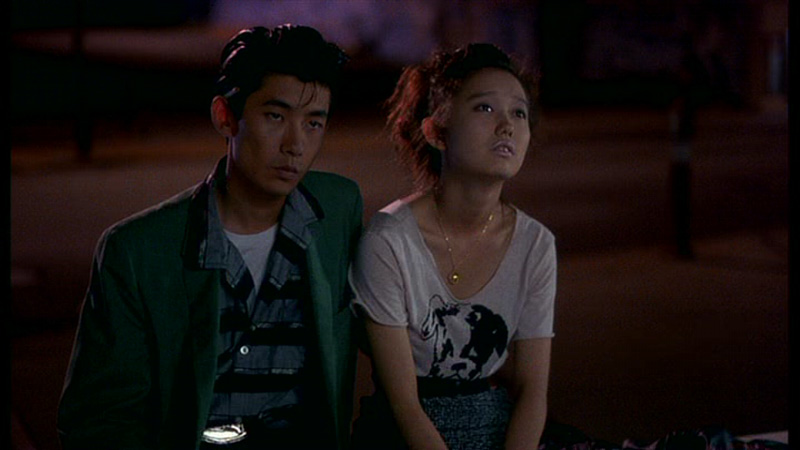
Mystery Train


Mystery Train (1989)
Starring: Masatoshi Nagase, Youki Kudoh, Screamin' Jay Hawkins
Written and Directed by: Jim Jarmusch
IMDB Listing

Photo by: DVDBeaver.com

Who wants to see a film with an actor named "Screamin' Jay Hawkins?" You know you do. Hawkins is actually the composer for many of Jarmusch's films, and appeared in Mystery Train as a sage old night clerk of a seedy, yet fated hotel. He's best known for his single "I Put a Spell on You," a truly hot song, now shafted and abused in jean commercials. There is no justice in the world.

But this strangely riveting film uses Hawkins to his best ability, as well as a host of other talented unknowns (you know you're indie when your biggest name is Steve Buscemi.) Mystery Train centers around a block of strangers in Memphis, including two young Japanese tourists (Nagase and Kudoh,) an a recently widowed Italian woman (Nicoletta Braschi) and a local barber (Buscemi.) They never actually meet in any significant way, but through different circumstances are forced to stay in the same motel on the outskirts of the city. It's a story about music and Elvis, about foreigners and strange happenings, about love and silence.

One would think another movie about the interconnectedness between human beings would be tired and pointless- the theme has been a favorite of directors since the dawn of time. But Jarmusch's freshness and originality keeps the idea alive. Jarmusch recently directed the wonderful Broken Flowers, and what seems to set him apart is his celebration of the mundane. He has a fantastic attention to detail, and a willingness to let a look or moment of silence steal the scene, which is rarely found in "mainstream" directors. Many people would find this merely dry and unmotivated (he is an acquired taste) but for me it's a wonderful demonstration of the world in all it's quirkiness and banality.

My favorite characters hands-down are Jun and Mitsuko, the Japanese tourists. Obsessed with 1950s American culture, they travel from city to city on the train, seeing rock-and-roll landmarks. Kudoh is both funny and charming as Mitsuko, the Elvis-obsessed girlfriend, dressed in a series of vintage T-shirts and carrying around a stuffed-dog purse. Nagase is similarly hilarious as Jun, Mitsoko's sullen yet loving boyfriend. The two are perhaps a bit of a caricature, but there's something about the way they carry the stereotypes that makes it entirely genuine.

Some of the best scenes belong to Hawkins, however, and the bellboy (Cinque Lee.) The smattering of conversation between the two lights up the movie. Though the bellboy is young, he seems like an old face in the hotel along with the night clerk. In the end they become part of the scenery itself- the broken-down, overgrown outskirts of Memphis, TN, barren and clinging to its glorious past.

A touching little piece of American cinema, Mystery Train allows us to explore the run-down beauty in our own backyard. It's well worth having a look at.

Sunday, March 12, 2006

The 40-Year-Old Virgin


The 40-Year-Old Virgin
Starring: Steve Carell, Paul Rudd, Catherine Keener
Written by: Judd Apatow and Steve Carell
Directed by: Judd Apatow

Photo by: Can Mag

As it is with many movies, The 40-Year-Old Virgin was one I had always meant to see, and "never got around to it." It was shameful, I know, to claim myself as a die-hard Carell fan, and not seen the movie that ushered him into stardom, but I had... stuff to do.

But no matter! I have seen it now, and can honestly say that I laughed until I cried. The chest-waxing scene, the speed-dating scene, the end with the whole cast belting out "Age of Aquarius" all had me falling off my chair. But it was the movie's inherent sweetness that really got me. In many ways, the DVD cover says it all- Andy looking glowing, boyish, full of wide-eyed naivete. Andy's virginity is not the only thing keeping him from happiness. He's a social misfit, the kid in high school constantly being stuffed in his locker. His whole demeanor is slightly uncomfortable throughout the entire movie, and you can feel his embarrassment. You feel sorry for Andy, and cheer for him, but not so much that you feel uncomfortable also laughing at him. It's a tricky tight-rope walk, and Carell walks it masterfully.

On the other side of the aisle are his gruff, but ultimately kind, friends (Paul Rudd, Romany Malco and Seth Rogan,) who all have advice for Andy's problem. They are really three icons of manhood- Jay (Malco) is the player, constantly cheating on his girlfriend and hitting on drunk girls in bars. Cal (Rogan) is the tattooed "man's man," opting for the aloof bad-guy approach. And Rudd is the SNAG (sensitive new-aged guy,) obsessed with his ex-girlfriend, loving her and hating her in the same breath. In the end none of these approaches work for Andy- only learning to grow up, giving away his precious action figures and admitting who he is gets him the girl.

But let's not get so sappy (or, God-forbid, read too much into this little gem) because in the end it's simply a fantastic comedy- one of the many recently coming from director/producer Judd Apatow and a new generation of comedians recently dubbed the "Frat Pack." I wouldn't be surprised if the chest-waxing scene went down in history as comedic genius, like Monty Python's "Knights who Say Ni!," or Tom Cruise's dance scene in Risky Business. Carell deserves the lauding he got when the movie first came out, and I'm also giving props to Catherine Keener, for her wonderful performance as the "hot Grandma" Andy falls for. Finally, Rudd, Rogan and Malco are absolutely hilarious as Andy's friends, without being too over-the-top (I expect to hear the 'Know how I know you're gay' sketch referenced mercilessly.)

It's been difficult lately to find a comedy that wasn't either completely forgettable, or something I only wish I could block from my memory. Carell is due to act in eight more films in the next three years; it'll be exciting to see what this meticulous comedian can come up with next.

Thursday, March 09, 2006

Melvin Goes To Dinner


Melvin Goes to Dinner (2003)
Starring: Michael Blieden, Matt Price, Stephanie Courtney, Annabelle Gurwitch
Written by: Michael Blieden
Directed by: Bob Odenkirk

(Photo Courtesy of sundancechannel.com)

Once in a very great while you find a movie that's surprising. And not horror or thriller movie surprising, with their so-called "plot twists," because that is far easier to achieve. I mean surprising in a way that speaks to you, that brings you in, and tells you to make yourself at home. Surprise achieved without the help of special effects or grand set design- the kind that can happen to someone walking down the street.

With that in mind, let me say that Melvin Goes to Dinner is the most surprising movie I've seen in a very long time.

Based on Michael Blieden's stage-play Phyro-Giants!, the movie is indeed about a guy named Melvin who meets three people for dinner. Most of the film is the conversation that ensues between the four relative strangers, and ranges from gut-bustingly hilarious to sad to reflective.
What is most extraordinary about these characters, and this movie, is how natural all these people are in their conversation, and their actions outside of the restaurant: they could be my friends, my family, the people I sit next to in class. Their experiences are experiences any of us could have. But their stories- their affairs, their unhappiness with their jobs, their sense of spirituality- are not mundane. They are beautiful and tragic. They are true to life, without ever seeming trite or cliched. It's so true that the "twist" at the end is simultaneously shocking and completely realistic.

The movie also has a terrific supporting cast, including Jack Black as a rational schizophrenic, David Cross as a motivational speaker and Maura Tierney as Melvin's sister. All these people are remembrances- part of the stories the four characters tell in the course of their evening. These people are distant from the four protagonists; it's as if the dinner party are in a world or a dream of their own, where openness and real honesty reigns supreme. When the waitress comes to tell them that they need to pay their bill, it's like some wonderful spell has been broken.

I bought this movie the day after viewing it. I plan to keep it for a day I need something truly surprising- something to help me pause my busy life and simply laugh and look at the beauty that can be found in anything. Even a dinner party.

Monday, March 06, 2006

The Good, The Bad and the Bombed

Email from my dear Mother Maven on the Oscars:

We will speak more of the Oscars BUT...When you have a woman as beautiful as the divine Charlize why, oh, why would you stick her in a dress that is 1) hideous and 2) doesn't even fit her. I was appalled. Did they dope her up in order to get her to consent? At some point in the evening did the opium wear off and she was suddenly confronted with the horror that she was? Has anybody checked on her today? I'm worried about her...

Indeed I am worried about Charlize who had to endure not only an Oscar loss (predictable though it may have been) but also wearing some sort of wrapped number that looks like it was made with green crepe paper. Let's hope the roofies have worn off.

I am also worried about our darling Jon Stewart; I put on a good face, showered him with a mother's affection, but the cold hard truth is he bombed. Hard-core. It would have been bad if he'd been actively horrible, but in the end he was just flat. Boring- an adjective I would never associate with Stewart, but there you are. And flat is worse. I lost interest. It was depressing to watch. Cintra Wilson smells a conspiracy against the beloved fake-anchor, and there is a yearning in my heart for it to be so, but we must face the truth: Jon Stewart bombed.

But the show went on. We were dragged through endless montages of classic films and themes, jumped up and down when Hoffman won for best leading role (I did in any case) and Crash inexplicably breezed by Brokeback Mountain to score best picture. The only major award I think Brokeback actually won was best adapted screenplay for Larry McMurtry and Diana Ossana, a huge surprise for the talking heads with all the "buzz." Don't get me wrong, Crash was an excellent film. And in the end it was safe movie. You mean there are racial tensions in L.A.? AND they're complicated?! Get out of town! But the Academy will go with what's safe- and, in the end, gay cowboys (or shepherds) are not safe. Cest la vie.

So it was a safe year for Oscar, with worthy films, and, if anything, announced the graduation of George Clooney from A-list star to Hollywood GOD, a la Jack Nicholson. Let's just hope he doesn't start wearing those horrible sunglasses.

A final word to our friend Jon Stewart, who is probably nursing a massive hang-over after drowning his sorrows in champagne:

It's all right Jon. We love you. People have bombed the Oscars before you, and they will bomb them after. Stiff upper lip, old boy. You are still our leading man.


Sunday, March 05, 2006

Oscar Coverage '06!!

'Lo all! Welcome to the 1st Annual Movie Maven Oscar Coverage- in real time!!

We've started the all-important Oscar countdown- the most important aspect of the awards, I believe, because who cares about Brokeback Mountain when there are swan-dresses to mock?!!
One of the anchors appears to be wearing some sort of stripper get-up with a sequined mid-section. Someone needs to be fired.

Matt Dillon. There's something about him that bothers me, but there's no doubt he's good with sleazy roles. It's that furrowed cave-man brow. It's good for sleazy.

I am truly, truly tired of entertainment journalists yelling at me. What did I ever do to them?

Dresses appear rather low-key this year. There's a rather refreshing lack of skin. It's a shame, but I'm not terribly good with the style commentary (check out my cohorts' blogs Fashionistas First and Style in the City for far better commentary than I could provide.) Oh goodness the countdown's over! Time flies when you're having fun, I suppose.

Truly surreal Oscar intro... Oscar himself overtowering the rest of the buildings... maybe paying homage to King Kong?

Oh God, Jon, please don't bomb.

This is taking too long- oh wait, Jon's in bed with George Clooney. Suddenly my interest has been renewed.

"I'm sorry to say Bjork will not be here today- she was trying on her Oscar dress and Dick Cheney shot her." There you go Jon, keep 'em coming...

Best Supporting Actor roles are up first... Nicole Kidman and her glorious Aussie self presenting... it's George Clooney!! So Matt Dillon and his forehead were defeated after all. Hooray!

Am I hallucinating, or is Ben Stiller in a green suit? Oh, he's doing the visual effects awards. That makes a little more sense... just a little.

Look at Nick Park's tie! And he has some for the Oscars too.

Has anyone noticed that Dolly Parton looks like a ventriloquists' dummy? Seriously- just look at her.

Oh dear god, they have two animated creatures presenting animated shorts. It's like I'm watching the Oscars while on hash. Between them and Reese Witherspoon there's too much cuteness going on in this show.

It's occurred to me how few movies I've actually seen. My friends think I've viewed every film under the sun, but there's still so much to see. Every time they name a film I think to myself, Oh yeah, I wanted to see that! But unfortunately food wins out over movies (by a small margin, but still.)

My friends appear to be not too keen on Russell Crowe, who's presenting. I don't care what anyone says- I love that he hit someone with a phone.

Oh Amy Adams. I know she won't win, but I want her to so badly. Her desperate friendliness in Junebug was so wonderful. But she won't win.

She didn't win. But it's ok, I'm quite fond of Rachel Weisz as well.

I stepped away from the TV for just a moment, and suddenly I have no idea what's going on. Another classical movie montage? The montage ode to King Kong and other monkey films was about as much as I could take.

I'm actually pretty pleased with Stewart's hosting. Here's a good quip, after yet another montage of social issue films like Guess Who's Coming to Dinner and The Grapes of Wrath: "None of those issues was ever a problem again."

A funny looking man claims to be the President of the Academy... Who exactly is the Academy anyway? Are they like the Freemasons or something?

Ohhhh... Technical awards... I'll see you in a bit folks. As much respect as I have for these workers of the cinema, and their capabilities, I can't watch sound editors, and mixers for the next hour.

We're back! And Clooney is doing the memoriam for those who have died. Solemn moment ensues... Oh wait we applaud their deaths, all right then.

STOP THE PRESSES!!! PHILIP SEYMOUR HOFFMAN HAS WON!!!

Let's just stop and reflect a minute on the sheer fabulousness of Philip and the enduring wisdom of the Academy. Solemn moment. Ok.

I suppose I should see Hustle and Flow. So how hard is it really out here for a pimp? Inquiring minds want to know.

Argh! The blasted penguins took Best Documentary. I knew they would, but I had wild fantasies where hordes of Werner Herzog fans take over and steal the Oscar of Grizzly Man's behalf. But no. Apparently adorable flightless birds trump murderous bears and the men who love them. Go figure.

And Witherspoon. I should be accurate and say I still haven't seen Walk the Line, so I shouldn't talk. Perhaps she brings June Carter's persona to grand new heights. But I've said it before and I'll say it again- that girl is too cute for her own good. Plus I don't think I can ever forgive her for marrying Ryan Phillipe.

Wow- they're already at Best Picture? I'm impressed Academy- just under four hours. They must have had Halle Berry gagged backstage.

And it's...... CRASH?!! Oh, I suppose I'm not that surprised- the Academy's big on guilt this year. But I'd hoped for Capote or Good Night, and Good Luck, sappy journalism nerd that I am.

Well there you are, folks! I'll write again tomorrow for a more, um, coherent run-down of the Oscars, (and perhaps rant a bit more on the great injustice done to Herzog.) Until then my Hollywood darlings, get some sleep, and rise bright-eyed and bushy tailed for endless post-coverage. Nighty-night!

A Quick Note

I will be covering the Oscars tonight, as they happen, ladies and gentlemen. So after the festivities, come to the Maven for all the coverage you could ever need. It's like the commentary after the State of the Union. Only more intelligent.

Also one of my culture heroines Cintra Wilson will be doing an Oscar simulcast along with Camille Paglia from their home at Salon. If you have never read Wilson's post-Oscar essays before you cannot miss this simulcast. So much better than watching Oscar commercials, which believe me are not nearly as cool as the Super Bowl's.

See you there!

Tuesday, February 28, 2006

Now that they're out of that blasted coffee shop...


I was flipping channels the other night when I caught a very old, rather funny episode of the pinnacle of '90s yuppydom, Friends. Oh look at them, I thought. All young and idealistic and of a normal body weight- it's touching. And it occurred to me that all of them at one time or another had made their way to the cineplex near you, with results varying from grand success to utter failure. So, at the risk of sounding like the screeching, peppy, j-school dropouts from Entertainment Tonight, I am compelled to ask...

WHERE ARE THEY NOW?

David Schwimmer- a.k.a Ross Geller
"David Schwimmer- yes, he is attractive in an ugly kind of way."- Homer Simpson

Poor David. Condemned to be the despised, up-tight paleontologist, it seems our Mr. Schwimmer is a one-trick pony, appearing in craptacular films such as The Pallbearer and Six Days, Seven Nights. The one exception is the fascinating TV movie Uprising about the rebels who stayed in the Warsaw ghetto after the Nazi's began shipping them off to concentration camps. I wasn't sure about casting Schwimmer- I feared I'd be watching a Holocaust movie and be constantly thinking Hey, look, it's Ross! But I was pleasantly surprised by Schwimmer's steely portrayal of Yitzhak Zuckerman. But Schwimmer apparently seems content at being in films such as Madagascar and dubiously titled comedy Run, Fat Boy, Run which has just been announced, and which he is apparently directing. God help us all.

Courtney Cox-Arquette, a.k.a. Monica Geller

I always hated Monica- the anal, twitchy clean-freak sister of the Geller family. I think the Geller siblings were in fact the most universally disliked, and I always rather admired Cox for playing such an irritating personality. I have a bit of a weakness for this actress actually- I thought she was charming in the Scream trilogy as bloodsucking reporter Gale Weathers, and I even liked her in fabulously trashy Ace Ventura: Pet Detective. She's a "fun" actress to watch- comparable to eating an entire bag of Jolly Ranchers while watching soap operas- you know it's not healthy and is probably killing brain cells, but it has its own special charm. Not a lot of her new movies look terribly promising (one is Barnyard where she voices a cow, another is Zoom about romping teenagers stalked by a killer,) but they'll be good for a Saturday video night.

Matt LeBlanc
- a.k.a. Joey Tribbiani

I have just three words for you, people- Lost in Space. 'Nuff said.

Lisa Kudrow- a.k.a. Pheobe Buffay

Kudrow as flaky new-age Pheobe was always under-used in this show, and she's clearly the most talented of the lot of them. From the sly and very funny Romy and Michele's High School Reunion to the dark Opposite of Sex, to her unholy portrayal of desperate sitcom star Valerie Cherish in HBO's The Comeback, Kudrow has consistently proven that she has the comedic grace, wit and timing of anyone. She hasn't announced anything new yet, but her last film was Happy Endings, which alas I have not seen yet, but got some killer reviews.

Matthew Perry- a.k.a. Chandler Bing

This one's a bit of a mixed bag. There was Serving Sarah and Fools Rush In, which were not bad, but not good either. But there was also The Whole Nine Yards, a decent screwball comedy, where the Bingster could use his rather limited range to great effect. To be sure, it was basically Chandler Bing if Chandler lived next to a hit-man (Bruce Willis,) but Perry pulls it off in style. According to the good people at IMDB, he's in an intriguing new film called The Beginning of Wisdom about "the unusual romance between an aged Montana rancher and a young hippie." I'm always interested when a predictable actor is about to work on something a bit unpredictable, and we'll have to see if that range can stretch just a little bit further.

Jennifer Aniston
- a.k.a. Rachel Green

Probably the most successful of the bunch since leaving the show, Aniston, is probably also the most talented next to Lisa Kudrow. She's absolutely fabulous in Office Space (I hear the phrase 'pieces of flair' referenced at least once a week). And she showed she had real acting chops when she broke out with The Good Girl, playing one really desperate housewife. Unfortunately she has a dark past with skeletons like Picture Perfect and the truly ghastly Rock Star. But hey, everybody's got to make a buck, and there's still hope for redemption with her most recent, including one called Friends With Money co-starring Joan Cusack, Catherine Keener and Frances McDormand. Who needs Brad anyway?

So here they are- six people who were members of arguably the most famous cast in 1990's television. Some of them will shore up their reserves of talent and perhaps make a real contribution to cinema... some of them will do crappy half-baked spin-offs that make you want to beat whoever put up the dough to produce said piece of schlock. All of them will own their own small country some day and die richer than God.

But one wonders if perhaps as time goes by any of them will become like Kudrow's character Valerie Cherish: former sit-com stars desperate for the spotlight. Unable to break out of the role that defined them.

(Photo courtesy of Hollywood Auditions)

Monday, February 27, 2006

Credit Where Credit is Due


Unhappily holed-up in my apartment, absolutely covered in midterm storyboards, flashcards and analytical writings, it is safe to say I haven't seen a new movie lately. I am lucky enough, however, to be enrolled in a film analysis class, where I- get this- watch movies for homework. It's an excellent class, if only for the joy of understanding the true complexity of what goes into making a film. And I thought it might be interesting to name one or two people who don't get enough credit in this business.

Let's take a film I've been watching extensively for one of my midterms: the P.T. Anderson film, Magnolia. Most of the wonderful things I could say about this movie have already been said: a great ensemble cast, a positively stunning cinematic triumph, Tom Cruise is the man, two thumbs up, etc. etc.. And in my opinion, all these things are true (though I know many would disagree with me- this is a love-it-or-hate-it picture). But watching it now, I am stunned and impressed not by Tom Cruise, Philip Seymour Hoffman, or even P.T. Anderson.

It's Richard King who has my heart.

But who is King, you ask? He's the sound designer and supervising sound editor of Magnolia, a truly monumental task when you think about the ridiculous complexity of Magnolia's soundtrack. Each shot, especially in the beginning sequence played out under Aimee Mann's rendition of "One is the loneliest Number," has several layers of sound. One shot of Claudia in a bar has Mann's song, background noise, the sound of her jaw clicking, a voice-over from a TV commercial, and dialogue. In a nine second shot. All perfectly synchronized and constructed so that every layer is in harmony with the other, adding glorious, orchestrated dimension. Voice-over announcers, the sound of heavy breathing, and T.J. Mackey's strutting, profane sales pitch weave in and out of the opening sequence. The sound is only one aspect, of course, and it isn't necessarily the backbone of the film. But its seamless inclusion is matched with the acting, the setting, the cinematography- all the things that make the movie what it is. The melancholy sequence where all the principle characters sing along to "Wise Up," places the same importance on sound. Magnolia is about coincidence and commonality, and the music is many times the common thread that all the characters share. Whether you think it's beautiful or heavy-handed, you have to admit it's effective. And it's all thanks to Mr. King.

In the end I suppose it goes back to the idea of authorship of a film. To whom does Magnolia belong? The director? The writer? The production company? The first billed actor? Without any of these people the movie cannot be completed. So I think there really is no such thing as an "auteur"- an author or primary source. It works more, in my mind, much in the way a commune is supposed to. Yes, there is a leader of sorts, but without the staff as a whole, nothing gets done. In the end, whether a movie is good or bad cannot be put solely on one person. Its successes or shortfalls could be dependent on any number of people.

Like a sound designer.

(Photo of King courtesy of oscars.com)

Tuesday, February 21, 2006

Instead of doing real work...


I am busily surfing the web, searching for enlightenment, and have run across big, big news.

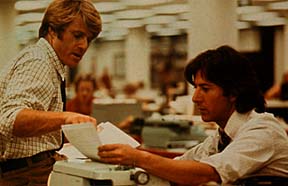
All the President's Men is coming out in a Special Edition DVD. Oh me, oh my.

The pivotal journalism nerd movie, redone and special featurized with commentary, etc., etc. Robert Redford, Dustin Hoffman and his floppy hair, and Hal Holbrook in that parking garage where it is always 3 a.m. and spooooooky. What more does anyone need?

Sunday, February 19, 2006

Oscars Taken Over by Actual Humor

Wait- what's that you say? The Oscar jokes may actually be funny this year?? Dare I dream it?

By now most of you have probably heard that the amazing Mr. Jon Stewart will be hosting this year's Oscars. My heart beats a little fast when I think that perhaps an entertainer's awards show may be, you know, entertaining. According to an article by the AP Stewart has his own writers working on his act as well as keeping up with The Daily Show. I'll be quite interested to see what they come up with. For now, here's a few hints to hold you until March 5:
"You're gonna see a ton of 'Munich' stuff. Lots of hilarity to be mined there," Stewart deadpans. "This would not be the easiest song parody in the world to pull off. Not a whole lot rhymes with 'Syriana' or 'Capote.' "

Freedomland


Freedomland (2006)
Starring: Samuel L. Jackson, Julianne Moore, Edie Falco
Written by: Richard Price
Directed by: Joe Roth
Official Website
(Photo: Moore and Jackson, courtesy of Movies Online)

Freedomland is not a pretty movie. It's designed to make one uncomfortable, to make one reconcile what we want to see and what we know to be true. But despite it glorious moments and performances, it is also an uneven movie that has to stretch a bit too far.

I would argue that the best thing about Freedomland is its beginning. It starts in the working class, mainly African-American neighborhood in Dempsey, NJ. The neighborhood's inhabitants are out and about- playing basketball, sitting on their porch and talking. A pale, white woman shuffles past them, moving slowly but purposefully down the street. The woman, who we will soon meet as Brenda (Julianne Moore) walks out of the neighborhood, and into the local hospital- leaving a bloody handprint on the door. By the time the final opening credit rolls, as Brenda is showing her injured hands to the doctors, you will be hooked.

Brenda's story is that a black man car jacked her, with her son in the backseat as she was trying to drive out of Dempsey into the mainly white neighboring town of Gannett. The case is given to Detective Lorenzo Counsel (Samuel L. Jackson) and as he begins to investigate, long-standing racial tensions in the neighborhood erupt in violence.

Both Moore and Jackson are at their best, although I would say Moore's performance tends to go a little overboard. Visually she's the very form of grief- her hair is bleached out, lank and oily. Her eyes are like black pits, and she looks like she hasn't slept or showered in days. But she turns Brenda into a character instead of a flesh-and-blood human being, which gets a little grating. Jackson likewise makes Counsel loud and a little hysterical. As much as I love Jackson's acting in this film, his performance starts to mimic the parody of himself on Chappelle's Show. Edie Falco does a splendid turn as a search party coordinator, simultaneously kind and businesslike, maternal and steely. Her scenes are shorter and quieter, but they are some of the most affecting in the film.

While the story grips you and the performances are at times exquisite, there is still something not quite right about the movie as a whole. I haven't read the novel, also written by Richard Price, but I know it runs about 600 pages, which leads me to believe that the film might suffer from adaptation-itis. In other words, there's simply too much crammed into the film to be entirely effective. There is a real sense of hysteria in the movie, perpetuated in part by the hysterical performances and the sense that it is rushing to tell the story.

But there are also moments of perfection in Freedomland. There is one point, for example, during the riot where Counsel catches a boy, probably in his early teens, trying to light a box on fire. As Jackson yells at him, you realize the boy's eyes have turned completely dead. It is a chilling moment- we have witnessed the destruction of the boy's childhood, of his innocence. These little moments of introspection bring the film out of mediocrity and showiness, to create something genuinely fascinating to watch.

Thursday, February 16, 2006

Sommersby


Sommersby (1993)
Starring: Richard Gere, Jodi Foster, Bill Pullman
Written by: Nicholas Meyer and Sarah Kernochan
Directed by: Jon Amiel
Official Website (IMDB)

(Photo: movie poster courtesy of IMDB.com)

Caution: A few little spoilers are in this review.
After my embittered former post on Valentine's Day, I feel I should talk about some real romance. Last weekend I had a DVD marathon as the Nor'eastah (as the locals say) gave us all here in Boston a good pounding. While working my way through my collection until the wee hours of the morning, I came upon Sommersby- a period gem I hadn't seen in a while. I curled up by the heater with some hot cocoa and a wooly blanket and popped it in with ecstasy.

Based on the French film The Return of Martin Guerre, Sommersby centers on a tiny Southern town and the return of the village's patriarch, Jack Sommersby six years after the end of the Civil War. He returns to an exuberant, but war-ravaged town, and his dubious wife Laurel who is none too pleased to see him. The man claiming to be Sommersby looks and sounds as he should, but his new kind and generous nature eventually casts suspicion on him and the life that he and Laurel have built together. When Sommersby is arrested for murder, he must choose between life (and death) as Jack Sommersby or admitting who he really is.

Believe me, there's some hot stuff going down under the humid Southern sun- Gere and Foster are amazing as usual, both as individuals and with each other. Bill Pullman, who I can usually only see as the President from Independence Day is actually quite fiendishly good as Laurel's jilted lover Oran. And James Earl Jones takes a cameo as a (gasp!) African-American judge, with his Darth Vader voice and fabulous delivery. It's classically filmed, which means lots of wide shots of hills and valleys, church steeples and people in wagons. It makes for a comfortable movie, rich and enthralling to watch.

The movie's a tad superficial in some ways, especially when attempting to deal with the complex issues of Reconstruction, race relations and the birth of the Klan. The problem with this kind of historical fiction is that the primary plot line is a love story completely detached from world or nation events. Then these events are diluted and simplified, and thrown in the mix almost as an after-thought. The one exception is Sommersby's scheme to grow tobacco in the fields and sell portions of his land to anyone who can pay- no matter what color their skin is. As the townspeople debate this, they are revealed as a cross-section of most of the South- happy to be alive, but broke, war-weary, unemployed and caught in a world that is strange and unfamiliar. They want to keep to the old ways, but they are beginning to realize that it's impossible.

But as I said, this is primarily a love story, and a good one at that. Both Gere and Foster specialize in sultry, longing gazes, and grand declarations of love. The courtroom scene where Sommersby must prove his identity (and by doing so, cementing his guilt), is especially swoon-worthy in the best, most Hollywood-like manner. Jack puts Laurel on the stand who claims that he is not her husband. He berates her, asking her repeatedly how she knows, until finally, spent, she cries out, "I know because I never loved him the way that I love you!"

Oh Lord, I do believe I'm going' to faint.

Sunday, February 12, 2006

The Only Movie I Ever Walked Out On


Diary of a Mad Black Woman
Starring: Tyler Perry, Kimberly Elise, Shemar Moore
Written by: Tyler Perry
Directed by: Darren Grant
Official Website

(Photo: Tyler Perry and Kimberly Elise, courtesy of cinemaeye.com)

On this Valentine's Day, the day of lovers, chocolate manufacturers and weepy single girls gorging themselves on Haagen-Dazs, I would like to post on the subject of commitment. Commitment, that is, to a movie. Whenever I go to see a movie I form a bond with that movie for the next two to three hours. I have paid exorbitant amounts for my ticket, snuck in my Big Box of Raisinettes and Diet Pepsi, and perused the coming attractions posters in the lobby. I have settled myself in the perfect seat in the back of the theater, so I'm not that tall girl with the big head that the person behind me can't see around. Plus, if someone answers their cell phone during the movie I'm in prime position to pelt them mercilessly with Raisinettes.

In short I have formed a monogamous, committed relationship for however long the movie lasts.

Now I've had wonderful, engaged relationships with many movies based on this perseverance, which have enriched my life and eventually enlarged my DVD collection. Unfortunately this commitment also attracts the losers, the betrayers, the liars- the "scrubs," if you will- in cinema. I have been taken advantage of by bad editing and crappy dialogue- I have been cheated on and stolen from by lousy mise-en-scene. These movies are the bad boyfriends of the film world.

And yet, I have sat through them. The train wreck that was The Ring 2, the deadbeat, no-good trash of A Guy Thing. The cheesy, overwrought Harry Potter adaptations (only the ones Chris Columbus laid his filthy hack paws on), and the depressing and neurotic Jack and What Dreams May Come. The list goes on and on. I have sat through them all, whether it was because my friends dragged me to it, or a date paid for me, or I honest-to-God had thought it would be good. Because I believe in monogamy. I believe in commitment to one's movie-going experiences.

Save for one.

The only movie I ever walked out on is Diary of a Mad Black Woman, the comedy by Tyler Perry. It was one I thought would be good. A friend and I were bored, and it looked funny. And the first twenty minutes weren't so bad. I eased myself into cheesy movie mode. Helen (Kimberly Elise) is kicked out by her evil rich husband (Steve Harris) who's having an affair, and is forced to move in with her kooky grandmother Medea (Tyler Perry), and meets the poor but ruggedly handsome moving man Orlando (Shemar Moore). Romance! Laughs! Men dressing up as crazy fat old women! Fun for the whole family, etc. etc.

I don't remember the exact moment when it hit me. Maybe it was during one of the many scenes where Helen's pothead grandfather (also Perry) makes a fool of himself. Or during the bizarre, gag-inducing session Helen has with her mother about the awesome power of God's love and how it will heal her pain. Or maybe during the extensive bouts of voice-over, meant, I guess, as diary entries, but really more like the ignorant jaw-flapping testimonials on the Real World. I'm not sure when, but at some moment it dawned on me that this was the worst movie I had ever seen. It was intolerable- I was so disgusted that people actually spent money to make this movie I knew I had to leave. My relationship was tainted. Commitment just wasn't enough.

I glanced at my friend, who looked about as happy as I was with the proceedings and asked if she'd like to go. She looked like I had just offered her water in the middle of the Sahara and nodded enthusiastically. We left during the "pivotal" love scene between Helen and Orlando (Will they kiss or won't they- Oh, I'm on the edge of my seat!!). I have never seen the end of that movie- apparently Charles almost gets killed or something, and Helen must choose between crappy, but rich and repentant ex-husband and hot, romantic but poor Orlando. I think her grandfather might also get high and stumble around a lot, but don't quote me on that.

Commitment to one's movie is a beautiful thing. It keeps us watching even after we've figured out how it's going to end, and keeps us in tune with the good bits even a bad movie can include. But like all relationships, we shouldn't ever fear walking away if that's what's required for our mental health. Because someday you might find the hot, romantic Orlandos of the film world. And you don't want to have wasted your ten dollars on a scrub.

Friday, February 10, 2006

In Addition

Just found this whilst wandering about the blogosphere- a very good article by our friend Lance Mannion. While it mainly pretains to nudity in film, it also addresses necessity vs. gratuity of sex and violence. Enjoy!

Thursday, February 09, 2006

Say, They Said You Were Stupid


Some Like It Hot (1959)
Starring: Marilyn Monroe, Jack Lemmon, Tony Curtis
Written by: Robert Thoeren and Michael Logan
Directed by: Billy Wilder
Official Website

Gentlemen Prefer Blondes (1953)
Starring: Jane Russell, Marilyn Monroe, Charles Coburn
Written by: Joseph Fields
Directed by: Howard Hawks
Official Website (IMDB)

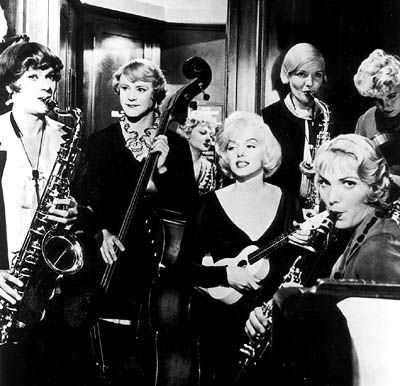
(Photos: Left: Monroe, courtesy of suetuthill.com. Right: Lemmon, Curtis, Monroe courtesy of flickr.com)

I've had the distinct pleasure of viewing two Marilyn Monroe films lately and decided to speak a bit on my woefully incomplete knowledge of her work and life. She's always fascinated me, in the way that all tragic characters fascinate- with a mixture of glorification and hero-worship and morbid curiosity.

The first movie I saw was Some Like It Hot- an old favorite of mine. For those who have seen it (and shame on you if you haven't) it's more like a security blanket or cup of hot cocoa than a film, from the first shot of the grim-faced gangsters to the last unforgettable line- "Well, nobody's perfect." It surrounds two musicians (Tony Curtis and Jack Lemmon) during the 1920s who have to flee Chicago after witnessing the St. Valentine's Day Massacre. They decide to dress as women and hide out in an all-female band headed to Florida. On the way they meet Sugar Kane Kowalczyk (Monroe,) the band's beautiful lead singer and ukulele player. And then the fun begins.

I could ramble at considerable length about all the things that are fabulous about this movie (the sheer comic genius of Lemmon and Curtis, the plot that's both satisfying and engrossing, and the great music are just a few things that come to mind) but what really struck me watching it this time around was Monroe's talent. I mean, real talent. Some could consider her part a throwaway bit- the gorgeous, if ditzy blonde romantic interest- but Monroe takes it on with grace, sweetness, and surprising wit. She keeps pace perfectly with her two co-stars and all three play off of each other beautifully.

The second film was Gentlemen Prefer Blondes, a musical which I had never seen before (I know, I know, shame on me). This one has two lounge singers Dorothy and Laralei (Jane Russell and Monroe) on a transatlantic cruise to France... and then the fun begins. Monroe is again the scheming dumb blonde, while Russel is her intelligent, sensible friend. Zany and predictable and giddily sexist, it's an example of classic '50s movie making, and the humor stands up pretty well today.

It's a little painful to watch Monroe now, years after her tragic (and common) demise; after hordes of biographers and historians and enthusiasts have unearthed every torrid detail of her short, brutal history. I hadn't known much about Monroe, besides the fact that she was a size 14, married Joe Dimaggio, and killed herself in her mid-30's. But just reading down the mini-biography in her IMDB profile is depressing.

-Mother was a deranged film cutter at RKO that abandoned her to a sequence of foster homes. She never knew her father.
- She was nearly smothered to death at two, nearly raped at six.
- She was paid a nickel a month at the LA Orphans home for kitchen work- they took back a penny every week to go to the church.
- She married three times, with no marriage lasting more than four years. When she married playwright Arthur Miller she didn't own a veil to match her beige dress and dyed one with coffee.
- She was also smarter than anyone gave her credit for: she owned more than 200 books, including Tolstoy, Milton and Whitman, loved Beethoven and studied at the Actor's Lab in Hollywood and took literature courses at UCLA. This really interested me. In my mind it goes along with the fact that she struggled all her life to become a "serious actress"- she wanted to be respected, not just gawked at.
- Four months after being dropped from the movie Something's Got to Give, she was found in her Bentwood home lying face down, nude on the bed, dead apparently from a drug overdose.

All these facts seem inconceivable when watching Monroe. She's known for her sex appeal, but what always struck me was the childlike enthusiasm and innocence she brought to her roles. I think for many people this translated to "dumb blonde," but it was more subtle than that. In many ways it was a complete departure from who she actually was. It takes a lot of talent to pull that off.

There's a moment at the end of Gentlemen Prefer Blondes when Loralei explains to her beloved's millionaire father Mr. Esmond (Taylor Holmes) the practicality of her wish to marry a rich man. "If you had a daughter," she asks, "wouldn't you want her to have everything she wants?"

"Say, they said you were stupid," says Mr. Esmond. Loralei flashes him a smile and tellingly confides, "Oh, I can be smart if it's important. But I know men don't like it very much." It's the secret that Monroe lived her life by- the reason she never got the career she wanted. And it's the reason she's still viewed only as a sex goddess, no matter how many shelves of Milton and Tolstoy she may have possessed.

Tuesday, February 07, 2006

Irreversible


Irreversible (2002)
Starring: Monica Bellucci, Vincent Cassel, Albert Dupontel
Written and Directed by: Gaspar Noe
Official Website (in French)

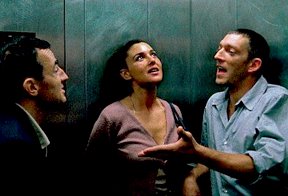
(Photo from left to right: Albert Dupontel, Monica Bellucci, Vincent Cassel, courtesy of Exclaim!)

I'll begin today by saying that I am not a squeamish girl. From P.T. Anderson to Tarantino, I've been able to watch most violent or sexual films without flinching. While watching Requiem for a Dream, I was the only one in my group who wasn't bothered in the slightest by the scene where Jennifer Connelly does very bad things to get a fix.

So when I say that watching the film Irreversible ruined my day, I want you to get my full meaning.

The French Memento-like film follows the fates of three friends (Monica Bellucci, Vincent Cassel and Albert Dupontel) in reverse chronological order, as one is brutally attacked and the other two go on a rampage of revenge. The film is infamous for its graphic violence and seven-minute rape scene. My film analysis professor showed the movie yesterday, adding a long disclaimer about the nature of the film and said she would understand if we couldn't handle it and needed to step outside.

I've received such dire warnings in the past and have never really heeded them. I take any graphic film I see as a challenge to view it and decide for myself whether the content was necessary to the meaning of the film, or merely gratuitous. But in this case I am loathe to make a decision.

Stylistically, the film works. Swooping camera movements and pulsating music serve to disorient (or, as my professor put so delicately, induce vomiting.) It's well-acted and edited, etc., etc. Since it is shown in reverse, the denouement serves as the set-up, and the climax is followed by a steady downgrade of action. Unlike Memento, there is no "other climax"- no great revelation, just a simple fading away of the momentum of the movie. From this standpoint it is sincerely interesting to watch.

But the film is "problematic," as critics are so fond of saying. The rape scene, unlike most of the film, is shot straight on, without cuts for approximately seven and a half minutes. What this means is that there is absolutely nothing distracting the audience, even briefly, from the action. The scene is horrible, endless, and terrifying- it is every woman's worst nightmare played out on the screen. This is in addition to a few other scenes of grotesque brutality (the one that stands out to me is when a man's head is bashed in with a fire extinguisher.) The film in general violent tone, perpetrated by the camera movements and hysteria of the film's protagonists. The film left me with a bad taste in my mouth; I felt uneasy and a little sick the rest of the day. I don't think a film has ever affected me emotionally to this degree.

So the question is, is it a good film? There's no doubt that it's effective, but was it necessary? Is it good simply because it evokes extreme emotions from its audience? Does it's admittedly well-executed style outweigh its content? I honestly don't have an answer to that, because what it ultimately boils down to is the age-old cinema question, how much is too much? And everyone has a different answer to that quandry. So I'll just say this:

Irreversible is a good movie.
I never want to see it again.

Saturday, February 04, 2006

Bleak House


Bleak House (2006)
Starring: Gillian Anderson, Denis Lawson, Anna Maxwell Martin
Written by: Andrew Davies
Directed by: Justin Chadwick (Episodes 1-4); Susanna White (Episodes 5 and 6)
PBS, Sundays 9 p.m. Eastern
Official Website

(Photo: Gillian Anderson, courtesy of PBS)

Normally I would not delve into the magical world of TV, simply because I am such an addict there would be too much for me to talk about. But I feel the inescapable need to tell about my new obsession:

Has anyone been watching Bleak House? If you haven't, please TiVo it, put it on the calendar, write it on your hand right now, because this lush new miniseries from Masterpiece Theater is too good to miss.

The series, based on Charles Dickens' classic, has a magnificent host of characters. Among others we meet cold and beautiful Lady Dedlock (The X-Files's Gillian Anderson, looking like she's been through the ringer, but still fabulous), corrupt lawyer Mr. Tulkinghorn (a snakelike Charles Dance), charitable aristocrat John Jarndyce (Denis Lawson), and his sweet, sensible housekeeper Esther Summerson (Anna Maxwell Martin). The plot centers around (among other things) an interminable inheritance case that, if won, will make Jarndyce's ward Richard Carstone (Patrick Kennedy) rich beyond his wildest dreams. All the characters appear to be in some way connected to the case, as well as a mysterious vagrant known only as Nemo, who dies in a boarding house in the first installment. In Dickens' world, everyone has something to hide, and skeletons appear to be bursting out of every closet from London to the ironically idyllic "Bleak House," where the Jarndyce's live.

I'll admit I began watching the series because of Anderson, who I enjoyed greatly in her work on The X-Files. And Dedlock does end up being the most interesting one to watch; she glides across the screen like a wraith, and is never fully present in the scene- she's completely consumed by a past not yet revealed. But all of the actors in Bleak House (and there is a mob of them) are interesting to watch in their own right. Dickens' specialty was always accurately portraying every class and personality of Britain with ease, and it's translated very well to the screen. Even the obligatory street urchin Jo (Harry Eden) is satisfactory.

I've never been much of a Masterpiece Theater gal; prior series I saw were too stiff, the camera shots were long and uninteresting, and the droning British dialogue a little stupefying. But Bleak House is different. Most of the installments take place in London, where everything is dirty and diseased, and all the extras look just a little miserable. There are jerky montage cuts which snap noisily between different shots of the same scene, throwing the audience off-kilter and keeping heart rates up. The characters are completely engrossing, and the plot is more scandalous than a modern soap opera, and far more well-acted.

Davies' patience in plot-development is reminiscent of the developments of the hit show Lost- he isn't worried about giving too much away, opting instead to allow the story to reveal itself at a steady, languid pace. Instead of making the audience lose interest, it captivates them. I've been staring impatiently at the clock the last few Sunday afternoons, tapping my foot and waiting for 9 o'clock (in fact, that's what I'm doing right now). And when it ends I always want more. In many ways the very fact that it's a miniseries is homage paid to Dickens' work. Salon film reviewer (and much more talented writer than myself) Stephanie Zacharek explained it very well:
"Bleak House" will be available on DVD on Feb. 28, almost immediately after the series completes its TV run. But nearly everyone I know who has begun to watch the show prefers to see it the old-fashioned way, on successive Sunday nights, as it airs -- a way of approaching Dickens' work that's not far off from the way his earliest reading public would await each installment of his newspaper serials. Dickens' biographer Edgar Johnson has written about how American fans waited at the docks in New York, shouting out to the crew of an incoming ship, "Is Little Nell dead?"
So while the rest of the world will be eagerly awaiting the outcome of the Super Bowl tonight, you can catch me sitting by the docks of my television set, hollering at the crew of the USS PBS "Tell me, who is Nemo?!"

Thursday, February 02, 2006

Junebug


Junebug (2005)
Starring: Embeth Davidtz, Alessandro Nivola, Benjamin McKenzie, Amy Adams
Written by: Angus MacLachlan
Directed by: Phil Morrison
Official Website

Left: Embeth Davidtz and Alessandro Nivola in Junebug (www.cinemaeye.com) Right: Benjamin McKenzie (www.yahoo.movies.com)

In a Hollywood dazzled by CGI, and based almost entirely on film’s value as a product rather than as a work of art, it is a rare pleasure to find a movie that’s understated and genuine, and almost devoid of “star power.” And that is precisely what Junebug is- a movie about the beauty, joy and heartache that can be found in simple, everyday things.

The film centers around art dealer Madeleine (Embeth Davidtz) and her new husband George (Alessandro Nivola) who travel to backwater North Carolina, both to see a brilliant but eccentric folk artist (Frank Hoyt Taylor) and to meet George’s family. At face value it seems like a very ordinary plot: the family attends a church social and a holds a baby shower for George’s sister-in-law Ashley (Amy Adams). Madeleine tries to convince the artist to sell his art to her. George’s surly brother Johnny (The OC’s Benjamin McKenzie) goes to work. Ashley goes into labor. But the plot becomes riveting purely by the characters that inhabit it.

Much of the cast are relative unknowns, and their on-screen chemistry with each other is terrific. But while Davidtz and Nivola may play the film’s protagonists, it is Adams and McKenzie that steal the show. You can’t take your eyes off of Adams as sweet, naive Ashley, nor McKenzie as seething, explosive Johnny. Their presence completely draws you in. McKenzie’s movements are especially captivating- his tense, jerky motions and shuffling stance show a man uncomfortable in his own skin and surroundings. George’s parents, played by Celia Weston and Scott Wilson are similarly suited to their roles. Weston plays the dubious mother-in-law with subtlety and ease, never beating the viewer over the head with her character.

The simplistic nature of the film is obtained by cinematographer Peter Donahue. The individual shots are longer than usual for a modern film, allowing the viewer to ruminate on the visual, and they create a sense of a slow deliberate existence. There’s also an emphasis on environment- shots of the house where they’re staying are used as ellipses between the scenes, as well as shots of the quiet neighborhood outside. The shots outside are especially wide and inviting, a view of an America uninterrupted, noisy only with the world of the woods beyond their back door.

What also really struck me was how familiar all of these scenes were to me. The scene at the church social brought me back to my own dry, florescent-lighted church basement, permeated with the smell of cheesy potatoes and rolls bought in bulk at Gordon Food Service. And I also know that house, covered in kitschy knick-knacks like porcelain birds on the walls and stuffed ducks on the old worn couch. A place drowning in Americana which is both absurd and yet strangely comforting. Junebug brings everything that’s wonderful, and terrible, about family and small-town life into sharp, inescapable focus.

Wednesday, February 01, 2006

Just a Little Ditty

There's a lovely post by Neddie Jingo today... it's mainly about his experience listening to John Barry's theme from Midnight Cowboy, but he expanded to talk about Movie Music in general, and the sounds that define a film. Here's a juicy little excerpt:

When was the last time you heard Movie Music? When I was a sprout, it was completely ubiquitous. "Moon River." "Che Sera, Sera." "Lara's Theme" from Doctor Zhivago. "The Godfather." "Suicide is Painless." "The Sound of Music." "Born Free." "The Look of Love," from Casino Royale. "Never on Sunday." "Raindrops Keep Falling on My Head." A major studio release was simply not made unless some hummable, radio-friendly, but ultimately adult -- what was then considered commercial -- piece of music could be identified with it. Poking around in preparing this post, I do find orchestral theme music associated with contemporary flicks, but can you hum a single bar of anything from, say, A Beautiful Mind? A hundred clams say you can't. There they all are. Say hi.
Neddie's enthusiasm led me to find more of Barry's work, which included the scores for Out of Africa, Casino Royale, and several Bond movies, including the original score from Dr. No. Unfortunately I am not a girl who can truthfully describe herself as a "music person." I am shamed to admit I haven't paid much attention to songs in film in the past, even though there are many who helped define the film. After all, what would Casablanca be without "As Time Goes By?" Or Star Wars without its pounding Darth Vader theme? Or, a bit more recently, High Fidelity without Jack Black's rendition of "Let's Get it On," or Magnolia without Aimee Mann, Fiona Apple and Jon Brion? But frankly, I remember High Fidelity because the film is about music, and I remember Magnolia because I have an unhealthy obsession with Aimee Mann. The only other recent films I remember the music from are biopics about musicians- Walk the Line, Ray, etc., which don't really count.

Just a thought to chew on along with your overpriced popcorn and Big Gulp.